Why Small Businesses Lose the Most to Cyberattacks
There is a myth in small business circles that says hackers only go after large enterprises. The thinking goes: why would a criminal waste time on a 20-person firm when they could breach a Fortune 500?
The answer is simple economics. Criminals don't want hard targets when soft ones pay just as well.
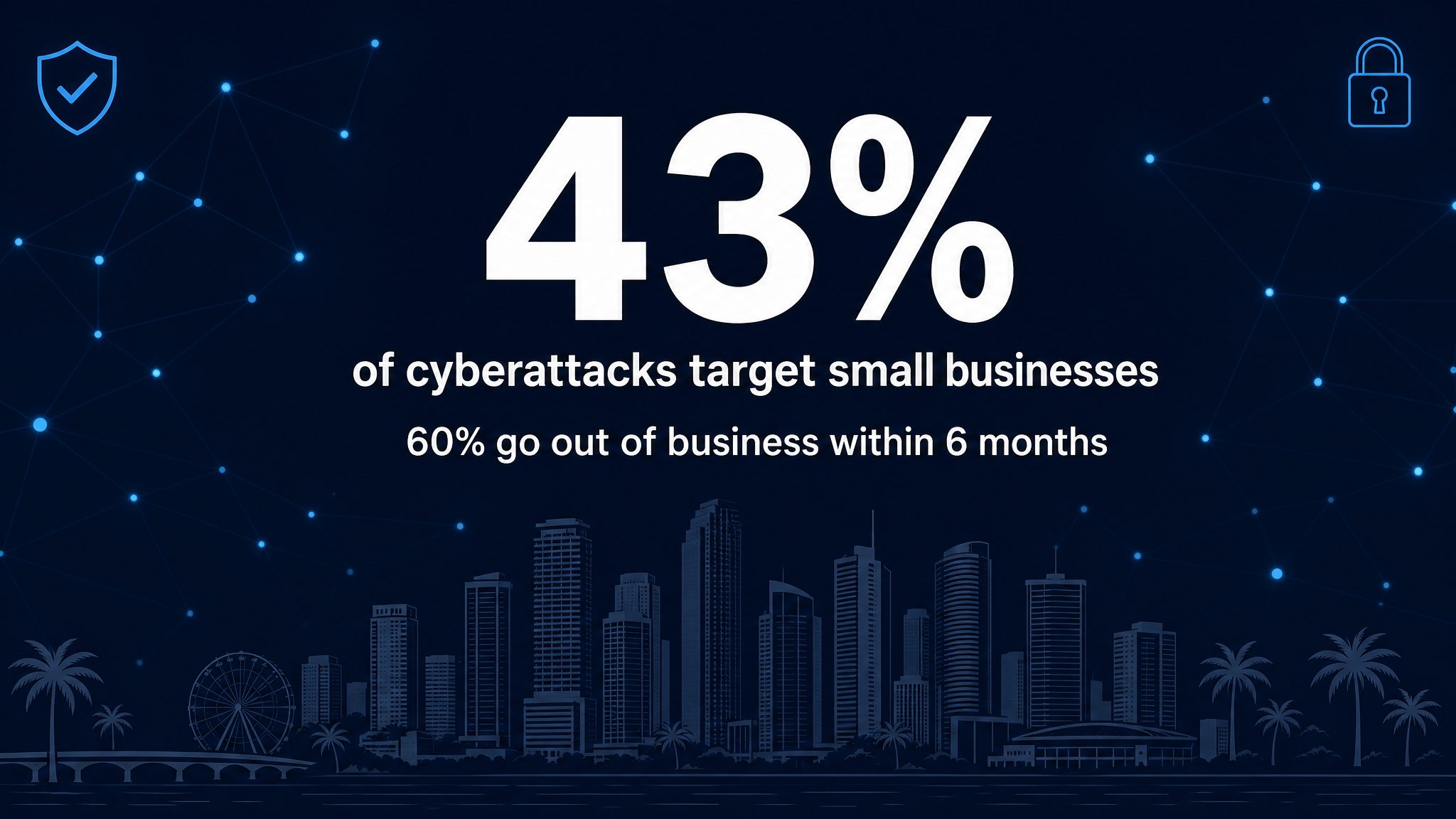
Of those businesses breached, 60% go out of business within six months. Not because the attack itself was fatal. Because they were not prepared to survive the aftermath: the downtime, the regulatory fines, the loss of client trust, the cost of recovery.
The asymmetry that kills small businesses
When a large bank gets hit by ransomware, they have Incident Response teams, cyber insurance, legal counsel, and capital reserves to absorb the shock. They have IT staff dedicated solely to security. They survive.
When a small business gets hit, the owner often discovers the breach the same way the criminals do: when the systems are already encrypted, or when a client calls to ask why their data is appearing on a leak site.
Most small businesses have none of the following:
- A dedicated IT security person
- An incident response plan
- Cyber insurance
- 24/7 monitoring of endpoints and network
- Current offline backups that are verified to work
They're running on a firewall set up five years ago and an antivirus subscription they forgot to renew. Meanwhile, the average ransom demand against a small business in 2025 was $150,000.
The difference between recovering and closing
Businesses that survive attacks share one characteristic: they had a plan before the attack happened. Not a plan written after the attack. A plan they had tested and refined.
That plan does not need to be expensive or complicated. It needs to answer three questions:
- How do we detect an attack? (EDR, monitoring, dark web scanning)
- How do we contain it fast? (segmented networks, user access controls, rapid response)
- How do we recover? (tested backups, documented recovery procedures, cyber insurance)
The window is closing
Cyber insurance premiums have doubled and tripled in the last two years. Insurers now require multi-factor authentication, endpoint detection, and dark web monitoring as conditions of coverage. Businesses without these in place are either paying dramatically higher premiums or getting denied entirely.
The businesses that waited until after an attack to take security seriously are no longer in business. The window for taking affordable, proactive steps is still open, but it is not open forever.
You don't need to be a large enterprise to have enterprise-grade security. You need a partner who treats your business like it matters.
Run a Free Dark Web ScanWhere to start
Start with a CyberSecurity Risk Assessment. This gives you a complete picture of where your exposure is, what a criminal would actually find valuable, and a prioritized roadmap for addressing your gaps. Most small businesses complete one in one to two weeks.
The difference between a business that spends $10,000 on a CSRA and a response plan versus $150,000 on a ransomware recovery is usually about $140,000 and six months of downtime.
One of those numbers is predictable. The other one is not.